Visual Paradigm Desktop |
  Visual Paradigm Online
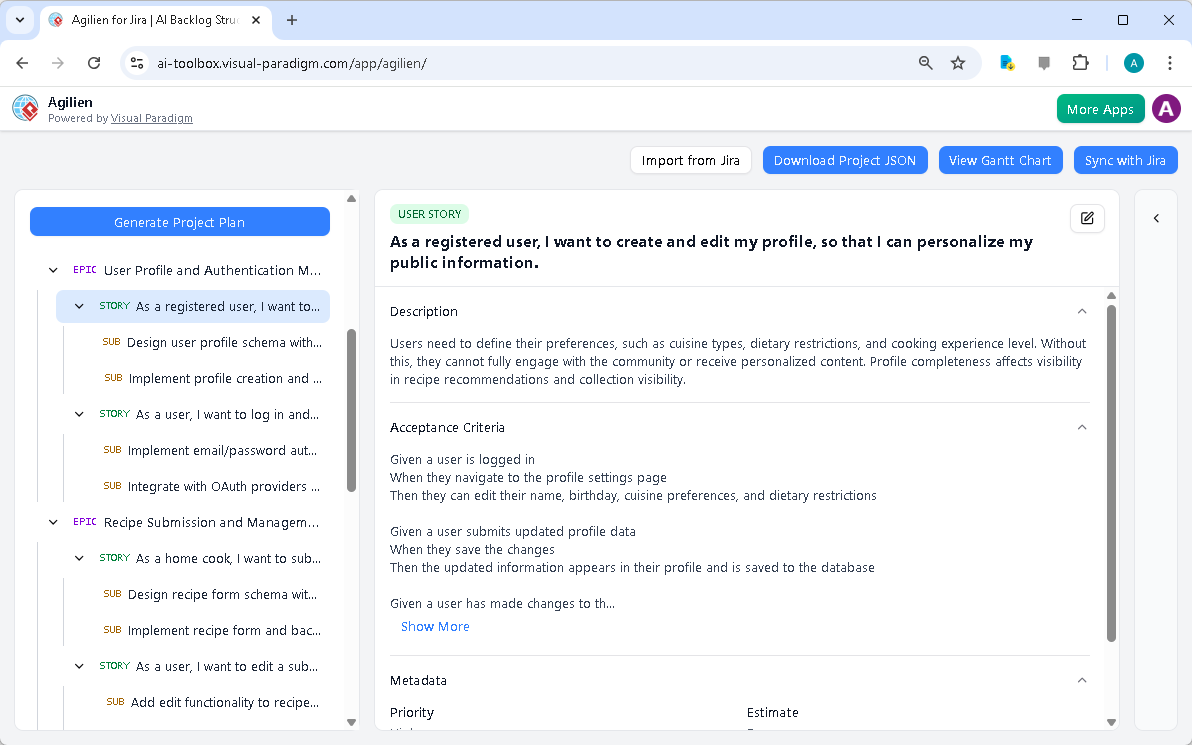
Imagine transforming a simple idea for a social network where users share and discover cooking recipes into a fully structured, actionable project plan in seconds. That’s the power of Agilien, the AI-powered project planning and software design assistant from Visual Paradigm. This tool is designed to eliminate the tedious, time-consuming work of breaking down a complex software idea into a detailed backlog. The screenshot above shows exactly how it works: by simply describing the project domain (“A social network for users to share, discover, and rate cooking recipes”) and the system context, Agilien generates a complete, hierarchical backlog with epics, user stories, and sub-tasks. This isn’t just a tool; it’s a game-changer for software development teams looking to accelerate their project kickoffs.
Agilien takes the guesswork out of agile planning. Instead of spending days or weeks manually brainstorming and organizing work items, you can focus on the creative and strategic aspects of your project. The AI engine, powered by advanced natural language processing, understands your requirements and translates them into a structured project plan that aligns with agile best practices. This allows product managers, software architects, and development teams to quickly move from concept to execution, ensuring everyone is aligned on the project’s scope and goals from day one.
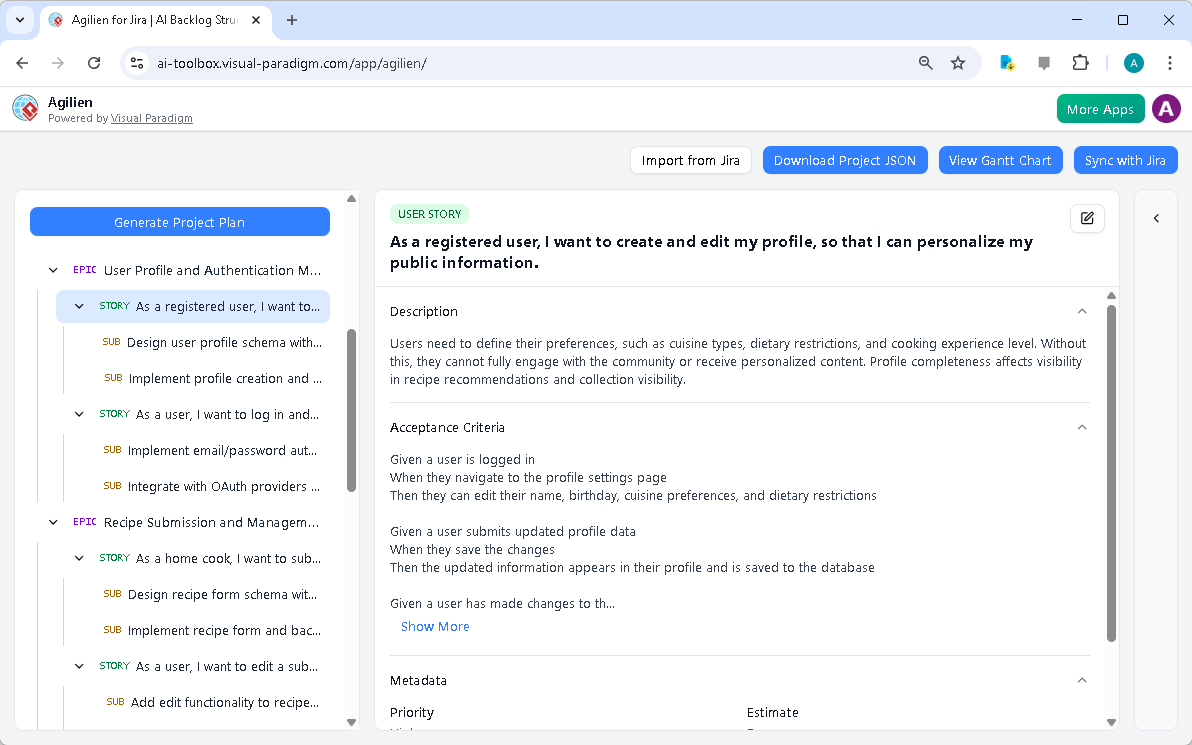
When you use Agilien, the process is remarkably simple and intuitive. The first step is to define your project. In the provided example, the user inputted a clear description of the social network’s purpose and core features. This initial input is the key that unlocks the AI’s power. Once you click the “Generate Project Plan” button, Agilien’s intelligent engine analyzes the text and automatically structures the project into a logical hierarchy. This hierarchy, visible on the left side of the interface, is organized into Epics, Stories, and Sub-tasks, creating a clear roadmap for the development team.
For the recipe sharing platform, Agilien has already identified high-level themes like “User Profile and Authentication Management” and “Recipe Submission and Management” as Epics. Under these, it has broken down the work into specific, actionable User Stories. For instance, one story is “As a registered user, I want to create and edit my profile, so that I can personalize my public information.” This story is then further decomposed into Sub-tasks like “Design user profile schema” and “Implement profile creation and editing functionality.” This level of detail is generated automatically, saving countless hours of manual planning and ensuring no critical requirements are overlooked.
One of Agilien’s most powerful features is its ability to bridge the gap between planning and design. It’s not enough to have a well-structured backlog; you also need a clear understanding of how the software will be built. Agilien solves this by allowing you to generate software architecture diagrams directly from your user stories. This ensures that the technical implementation is always aligned with the business requirements.
For the user story “As a registered user, I want to create and edit my profile,” you can select it and use the “Diagram Workbench” on the right. Here, you can choose to generate a Sequence, Activity, or Class diagram. The AI will analyze the story’s requirements and generate a visual representation of the system’s behavior or structure. This is a huge time-saver, as it eliminates the need for developers to manually reverse-engineer the design from a text-based backlog. The generated diagrams are not just static images; they are living documents that can be viewed, edited, and attached directly to the user story in the Detail Panel.
Adopting Agilien offers a range of significant benefits that can dramatically improve your software development process. The most immediate advantage is the acceleration of project kickoffs. What used to take days of planning can now be accomplished in minutes. This allows teams to start development much faster, getting their product to market sooner.
Another major benefit is enhanced clarity and alignment. By generating visual diagrams from your user stories, Agilien creates a shared understanding across the team. Product managers can see how their requirements will be implemented, while developers can get a clear picture of the system’s architecture. This reduces ambiguity, minimizes miscommunication, and ensures everyone is building the right thing.
Agilien also empowers your team by automating tedious tasks. The AI handles the initial structuring of your project plan and the first draft of your diagrams, freeing up valuable time for your team to focus on refinement, strategy, and innovation. This is particularly beneficial for startups and small teams that need to move quickly with a lean, integrated toolset.
Getting started with Agilien is straightforward. Simply go to the Agilien platform and define your project by entering a description of what you want to build. Then, click the “Generate Project Plan” button. Agilien will process your input and populate the project hierarchy with a complete structure of epics, user stories, and sub-tasks. From there, you can explore the plan, edit any details, and generate diagrams for any user story.
For teams already using Jira, Agilien offers seamless integration. You can import an existing project from Jira to use Agilien as your primary planning and design workbench, or you can sync your completed plan back to Jira to keep your official record up to date. This allows you to leverage Agilien’s powerful AI features without disrupting your existing workflow.
Agilien is the ultimate tool for teams that want to streamline their agile development lifecycle. It transforms the often slow and cumbersome process of project planning into a fast, efficient, and intelligent workflow. Whether you’re a product manager, a software architect, or a development team lead, Agilien can help you build better software, faster.
Ready to transform your project planning? Try Agilien today and see how it can accelerate your development process.
Visual Paradigm provides a comprehensive set of agile tools designed to improve backlog management, sprint planning, and team collaboration through visual modeling and AI-driven automation,,.
Agile User Story Mapping Tool – Prioritize Features Effectively: This tool allows agile teams to visualize product backlogs, prioritize features, and plan sprints effectively within a collaborative environment.
A Comprehensive Guide to User Story Mapping: This resource explains how to use story maps to align teams and prioritize development tasks to ensure overall project success.
Sprint Planning in Agile: Step-by-Step Guide: A detailed guide covering backlog prioritization, task breakdown, and team alignment for more effective agile project management.
Visual Paradigm Jira Integration – Seamless Diagramming & Workflow: This feature enables users to synchronize diagrams, models, and agile workflows directly within Jira to enhance project visibility and collaboration.
Agilien AI-Powered Jira Backlog Planner: This tool leverages AI to intelligently structure user stories and epics, facilitating more efficient sprint cycles for product management.
Adopting UML in Agile Projects – Comprehensive Tutorial: This tutorial explores the integration of UML into Agile workflows to improve planning, communication, and project clarity.
Unleash the Power of Agile and Scrum with Visual Paradigm: A guide demonstrating how specialized visual tools enhance planning, collaboration, and value delivery in Scrum practices.
Agile Methodology Tutorial – Principles and Practices Explained: A comprehensive resource covering Agile principles, frameworks, and practical applications within the software development lifecycle.
User Story Guide in the Agile Handbook: This resource details the full lifecycle of user stories, from initial concept to acceptance criteria and sprint implementation.
Enhancing Visual Modeling and Backlog Planning with Agilian: A tutorial showcasing how the integration of visual modeling enhances backlog planning and streamlines agile workflows.